
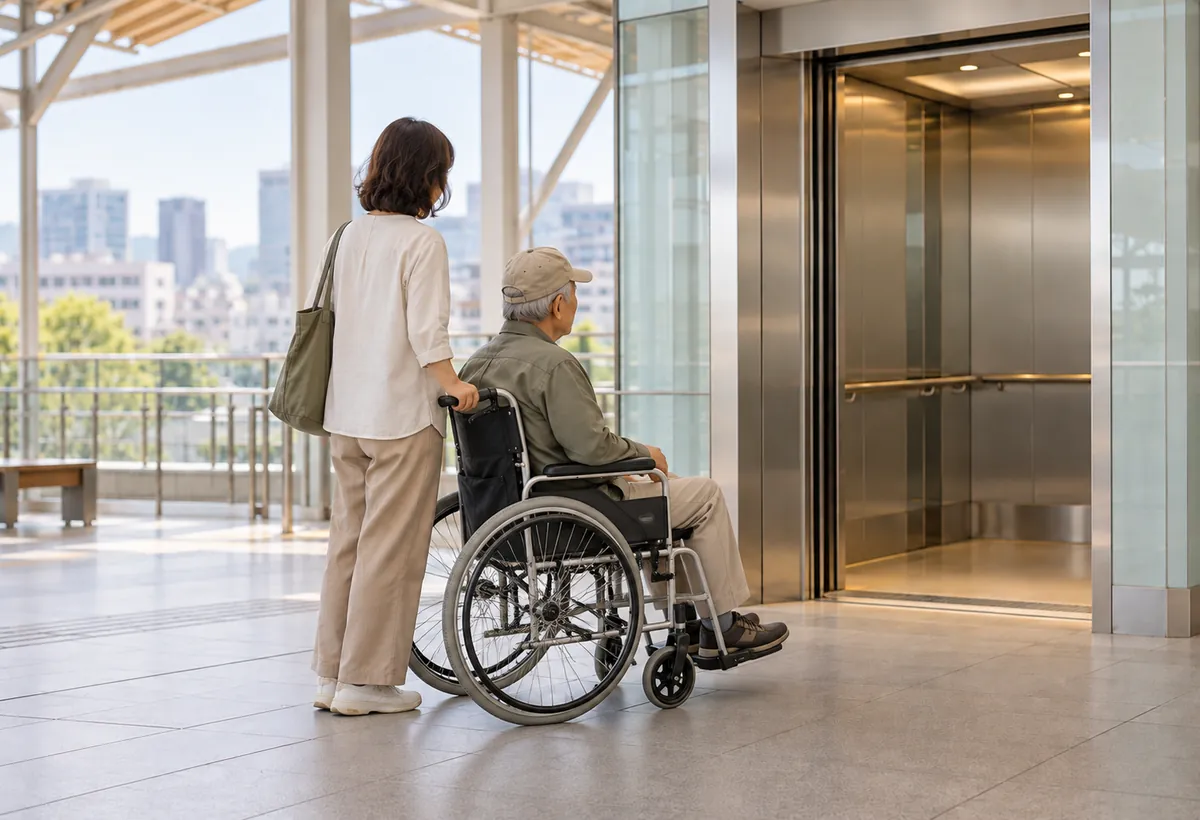
What this guide covers (and where to go for transport)
This page is about the equipment and the places: renting a wheelchair or mobility scooter in Japan, how barrier-free the attractions and lodging really are, and how to set all of it up from abroad for an older parent.
If your question is about getting between cities and through stations, that is a separate topic. Booking shinkansen wheelchair seats, using station elevators, and arranging staff assistance on trains are covered in our companion guide, getting around Japan with limited mobility. Read that one for the journey; read this one for the chair, the hotel room, and the temple.
The framing here is senior-specific, not disability-only. A parent who walks short distances at home but cannot manage a full day of standing, gravel paths, or temple stairs is the typical traveler we plan for. That person often does not own a wheelchair and does not think of themselves as a wheelchair user, which changes what you rent and how you ask for it.
For the wider trip plan, including pacing and visit length, start at the hub: traveling to Japan with elderly parents.
Wheelchair trip self-check
Answer these with your parent before booking rooms. Each one maps to a section below, and the answers decide whether a rental chair, a power chair, or a different hotel is the right call.
- Can your parent stand and move from the chair to a bed, toilet, or car seat alone, or do they need a hand?
- Who will push the chair on long days, or does the trip need a power chair?
- Has each hotel confirmed by name a barrier-free room with a bed, and either a step-free shower or a shower chair?
- Is a rental chair booked for the days of heavy walking, with delivery to the hotel or airport confirmed?
- For every temple or garden on the list, is there a checked accessible route or a flat alternative nearby?
- Is every medicine within a one-month supply for the trip? Above that, Japan's health ministry requires an import confirmation received before departure, as our guide to bringing medications to Japan explains.
Renting a wheelchair in Japan: what it costs
You do not need to ship a wheelchair from home. Visitors rent from three kinds of service: airport counters where you collect a chair on arrival and keep it for the trip, delivery vendors that send a chair to your hotel, and WHILL's own power-chair rental. The table uses the prices each service published when we checked on 2 November 2026. Confirm the quote before you pay.
A manual wheelchair costs about ¥1,500 a day at both the airport counters and the delivery vendor we checked. Delivery is what changes the bill. The MoVA counters are operated by ANA Holdings and booked through Veltra. They are at Narita Terminal 1 (South Wing 1F, International Arrivals, open 6:00 to 21:00), Haneda Terminal 2 (1F, domestic arrivals, open 10:00 to 18:00) and Kansai Terminal 1 (ANA domestic departures). The Haneda and Kansai counters sit in domestic areas, so ask the operator how an arriving international passenger reaches them. You can keep the chair outside the airport for the whole trip. The Haneda listing calls MoVA a trial at Haneda, Narita and Kansai and gives the period as 1 March 2026 to 31 March 2027, so a trip after that date needs a fresh check. NGT Care Rental, an Osaka company, delivers to staffed facilities such as hotels nationwide, remote islands aside. Round-trip delivery is added to the rental, so a two-day rental comes to ¥9,400 within Osaka city and ¥11,400 in Tokyo and other areas.
Power chairs cost much more once delivery is added. MoVA's airport counters charge ¥5,000 a day for a folding WHILL power chair. WHILL's own Model F rental starts at ¥49,000 for 4 days and reaches ¥99,000 for 30 days, both including ¥15,400 shipping anywhere in Japan. NGT's standard power chair is ¥29,000 for a 3-day minimum, plus ¥3,000 for each extra day and the delivery fee for your area.
Mobility scooters are far less common in Japan than in the US or UK. MoVA's Narita counter lists a mobility scooter from ¥6,000 a day for riders up to 115 kg including bags. WHILL's Model R costs ¥64,000 for 4 days and ¥114,000 for 30 days, including ¥29,700 shipping. It is delivered and collected only in Tokyo, Kanagawa, Saitama, Chiba, Gunma, Ibaraki and Tochigi. Outside that area, a folding power chair is the practical substitute.
Check the weight limits before you book. MoVA's standard manual chairs take riders up to 100 kg including bags, and the Narita listing adds a wide manual chair up to 130 kg. The Narita power-chair listing gives 100 kg or 115 kg depending on the model. The Haneda power-chair listing gives 100 kg in its headline and 115 kg in its booking conditions, so ask which applies. The Model F takes up to 115 kg and the Model R up to 147 kg, and WHILL says not to use either if the rider is too short to reach the footplate.
| Provider and equipment | Price | Pickup or delivery | Limits |
|---|---|---|---|
| MoVA by ANA: manual wheelchair | ¥1,500 a day | Airport counter at Narita T1, Kansai T1 or Haneda T2; booked on Veltra | Up to 100 kg; returning at a different drop-off chosen at booking is a limited-time option for returns by 31 March 2027; wide chair up to 130 kg at Narita; cancellation fee 50% the day before and 100% on the day or for a no-show (Narita listing) |
| MoVA by ANA: WHILL power chair | ¥5,000 a day | Same airport counters | Up to 100 kg or 115 kg by model and listing; ask before booking |
| MoVA by ANA: mobility scooter | From ¥6,000 a day | Narita T1 counter; booked on Veltra | Up to 115 kg including bags |
| NGT Care Rental: manual wheelchair | ¥9,400 for 2 days in Osaka city, ¥11,400 in Tokyo and other areas, then ¥1,500 a day | Delivered to the hotel front desk and collected there | Office open weekdays 9:30 to 18:30, closed weekends and public holidays; delivery to staffed facilities only, not airports or stations; English enquiries accepted |
| NGT Care Rental: power chair | ¥29,000 for 3 days, then ¥3,000 a day | Delivery fee for your area added | 3-day minimum |
| WHILL Model F (folding power chair) | ¥49,000 for 4 days to ¥99,000 for 30 days | Delivered anywhere in Japan; ¥15,400 shipping included; Haneda or Narita pickup for an added fee | 4-day minimum; up to 115 kg; online booking only |
| WHILL Model R (scooter) | ¥64,000 for 4 days to ¥114,000 for 30 days | Delivered in Tokyo and six nearby prefectures only; ¥29,700 shipping included; Haneda or Narita pickup for an added fee | 4-day minimum; up to 147 kg |
Delivery to your hotel or the airport
One option is delivery instead of visiting a shop. With NGT Care Rental, the chair goes to a staffed facility such as your hotel and is collected there, so there is no courier to meet.
Two practical rules make hotel delivery work. Get the hotel's permission first, because the front desk has to accept and store a parcel addressed to a guest who has not arrived yet, and give the vendor your reservation name and check-in date exactly as the hotel has them. Delivery areas differ by vendor. WHILL's Model F goes anywhere in Japan, its Model R only to Tokyo and six nearby prefectures, and NGT serves most of Japan at a fee set by area.
Airports are a separate option. NGT does not deliver to them, though it serves a hotel inside an airport. WHILL offers pickup and return at Haneda and Narita for an added fee, and at no other airport. Narita's own page says wheelchairs can be borrowed free of charge at any passenger-terminal information counter, for arriving passengers after passport control and customs. Haneda's page says wheelchairs for use as far as the aircraft seat are available to rent at its information counters, and does not state a price. Haneda also runs a WHILL autonomous-mobility service in the departure security areas of Terminals 1, 2 (domestic) and 3. It is free, takes no reservations, and is for boarding passengers only. Terminals 1 and 2 run it from 8:00 to 20:00 and Terminal 3 from 12:00 to 18:00. It is not available to people with a pacemaker, IV drip, peritoneal dialysis or oxygen cylinder, to anyone over 136 kg or under 140 cm, and it pauses from 13:00 to 15:00. A loan or ride inside the terminal is not the same as a rental you keep for the whole trip, so confirm which one you are booking. At Kansai, ask the airport's information counter whether a loan wheelchair is available and on what terms.
If your parent fatigues mainly on the airport walk and the first day, a short rental that starts at the hotel on arrival day may be enough. You do not always need the chair for the whole trip. For a stay of a month or more, one month in Japan for older travelers covers pacing and the rest of the planning.
Reserving from overseas before arrival
The cross-border setup is the part most guides skip, and it is exactly where an adult child booking for a parent gets stuck. You can arrange almost everything before the flight.
If coordinating this from another time zone in a language you do not read is daunting, that is precisely the gap we help with. Our accessible travel support service arranges rentals, delivery, and hotel confirmation on your behalf, and you can contact us with the dates and the parent's mobility level.
- Book early and confirm by email so you have the quote and pickup instructions in writing. Vendors publish no standard lead time, so 2 to 3 weeks ahead for a manual chair and longer for a powered one is a suggested margin. Read the cancellation terms first: the Narita MoVA listing charges 50% the day before and 100% on the day or for a no-show, and to change a booking you cancel and rebook. If a delayed flight lands after the counter closes, the booking is cancelled, and Veltra refunds it in full against a delay certificate.
- Send the vendor the hotel name, address, your parent's reservation name, and check-in date; ask them to deliver the day before or morning of arrival.
- Email the hotel separately to confirm they will accept and hold the delivered wheelchair at the front desk.
- Decide manual vs powered based on who pushes: if your parent travels alone or with another frail person, a power chair removes the need for a pusher.
- Keep the vendor's phone number and the return instructions on your parent's phone and on paper, in case of language issues at the desk.
- Match the rental dates to the actual days of heavy walking, not the whole trip, to keep costs down.
How barrier-free Japan really is (and where it is not)
Japan's modern infrastructure is genuinely strong on accessibility, and its old cultural sites are genuinely hard. Both things are true, and planning means knowing which kind of place you are visiting.
Since the Barrier-Free Act, airports, train stations, department stores, and shopping centers have been standardized with ramps, elevators, multipurpose toilets, and tactile paving. JNTO promotes ready-made barrier-free sightseeing routes (it lists dozens of accessible courses across Tokyo neighborhoods such as Shinjuku, Tsukiji, and Ueno, plus areas like Yokohama and Nagano). Modern museums, observation decks, and large shrines on flat ground are usually fine.
Old temples and shrines are the weak spot. Many sit at the top of stone steps, on deep gravel, or up steep approach lanes that no chair handles well. In Kyoto, a site like Kiyomizu-dera has signed accessible paths and a flatter approach with ramps and a lift, yet the famous Sannen-zaka and Ninen-zaka slopes nearby remain stairs and stone. Staff are helpful and often offer an alternative entrance, but help cannot remove a staircase.
Plan a mix. Pair one demanding cultural site (with a realistic accessible route checked in advance) with flat, reliable places: a department store rooftop, a riverside walk, a modern gallery, a garden with paved paths. For ideas on pacing a relaxed day, see taking an elderly parent out in Japan.
Accessible lodging: the questions that actually matter
Photos and the word 'accessible' on a booking site are not enough. The deciding details are room layout, doorway width, and the bathroom, and you only get reliable answers by emailing the property directly.
Useful Japanese room words to put in your email: 'bariafurii' (barrier-free), 'yunibaasaru ruumu' (universal room), and asking for 'beddo' (a bed) rather than futon. Many city hotels have one or two true barrier-free rooms that sell out, so book early and get the room type confirmed by name.
- Is there an elevator to the room floor, and how wide is the room doorway (in centimeters)?
- Is it a bed room or a futon-on-tatami room? Getting up from a floor futon is hard for many seniors.
- Is there a roll-in (step-free) shower, or only a tub? Roll-in showers are rare in Japan.
- Can a shower chair or shower stool be provided in the bathroom?
- Are there grab bars by the toilet and in the bath area?
- Is the room a 'barrier-free' or 'universal' room type, and can you reserve that specific type, not just request it?
- How far is the room from the elevator and the entrance, and is the path step-free?
- Is there a raised threshold (a small step) at the room or bathroom door?
The ryokan accessibility caveat
A traditional ryokan stay is on many wish lists, and it is the hardest accommodation to make accessible. Go in with eyes open.
Classic ryokan are built around tatami floors, futon bedding, raised thresholds, and a communal bath, none of which suit a wheelchair or a parent who cannot lower to and rise from the floor. The bathing area in particular is often off-limits to chairs. A wheelchair user can sometimes manage the room with help, but the bath and the tatami remain real obstacles.
There are workarounds. A growing number of inns and modern onsen hotels market barrier-free rooms with beds instead of futons, and some day-use onsen now add grab bars, lifts, and seated shower areas. A private open-air bath ('kashikiri') booked in advance avoids the communal bath entirely. If the onsen experience matters, plan it deliberately rather than assuming any ryokan works; our guide to an onsen ryokan with an elderly parent covers the bathing and privacy details. The flight itself has its own checklist, covered in flying to Japan with an elderly parent.
If a true ryokan is not feasible, a Western-style hotel with a barrier-free room plus a day visit to an accessible onsen often delivers the experience with far less risk.
Accessible toilets and finding them
Toilets are one of Japan's quiet strengths for accessible travel, and knowing what to look for removes a major day-trip worry.
What you want is the 'multipurpose toilet' (tamokuteki toire), a large single room usually positioned between the men's and women's facilities. They are common at train stations, inside shinkansen trains, department stores, and major attractions, and they typically fit a wheelchair, include grab bars, and often add a changing bench and ostomate fittings. They double as family and baby-change rooms, so they suit a parent who simply needs space and a handrail, not only wheelchair users.
Plan your day around reliable anchor points: large stations and department stores almost always have one. Convenience stores and small old buildings often do not. JNTO and city accessibility maps (such as Tokyo's barrier-free navigation resources) let you scout multipurpose toilets along a route before you go, which is worth doing for any full-day outing.
On the move, station and store staff will point you to the nearest multipurpose toilet if you ask, and most maps mark it with a wheelchair symbol.
Bringing your own vs renting locally
If your parent already owns a chair they trust, sometimes the right move is to bring it, but for most senior trips renting in Japan is simpler.
Renting locally means nothing to check at the airport, no damage risk to an expensive personal chair, a model sized for narrow Japanese spaces, and support if something breaks. The trade-off is fit: a rental will not be adjusted to your parent's body the way their own cushion and chair are.
Bring your own when the chair is highly customized, when your parent depends on a specific seating setup, or when they will use it constantly. Ask your airline well ahead whether it carries a mobility aid in the hold without charge, and what it requires for the battery of a powered chair. Smaller aids such as canes, rollators and shower stools can also be bought in Japan, and buying care supplies as a visitor covers what to expect. If the harder problem is having someone to push the chair and help at stations, travel helpers and paid care companions covers who can be hired for that.
A common middle path: bring a familiar cane or rollator for indoor and hotel use, and rent a wheelchair only for the long-walking sightseeing days.
Frequently asked questions
How much does renting a wheelchair in Japan cost per day?
A manual wheelchair costs about ¥1,500 a day. Collected at ANA's MoVA counters at Narita, Kansai or Haneda, that is the whole price. Delivered to a hotel by NGT Care Rental, a two-day rental is ¥9,400 in Osaka city and ¥11,400 in Tokyo, including round-trip shipping. Power chairs run ¥5,000 a day at MoVA, or ¥49,000 for 4 days from WHILL with delivery included. These are prices checked on 2 November 2026, so confirm the quote before paying.
Can I rent a wheelchair in Japan and have it delivered to my hotel?
Yes, with some vendors. NGT Care Rental delivers to staffed facilities such as hotels and collects the chair there, but not to airports or stations, and its hotel price is for two days. WHILL delivers its Model F anywhere in Japan with a 4-day minimum. Get the hotel's permission to accept the parcel first, and give the vendor the exact reservation name and check-in date.
Are temples and attractions in Japan wheelchair accessible?
Modern stations, museums, department stores, and large flat-ground shrines are generally accessible with ramps, elevators, and multipurpose toilets. Old temples are often not: many have stone steps, gravel, or steep approaches. Some sites like Kiyomizu-dera in Kyoto offer signed accessible paths, but nearby slopes such as Sannen-zaka remain stairs, so check each site's accessible route in advance.
Is a traditional ryokan accessible for a wheelchair user or elderly parent?
Most classic ryokan are difficult, because they use tatami floors, futon bedding, raised thresholds, and a communal bath that is often off-limits to wheelchairs. Some modern inns and onsen hotels market barrier-free rooms with beds, and a private reservable bath avoids the communal one. Confirm room type, bed vs futon, and bath access in writing before booking.
Can I arrange a wheelchair and accessible hotel in Japan from overseas before arrival?
Yes, and you should. Book early, with two to three weeks as a suggested margin (more for powered chairs), email the vendor the hotel and reservation details, and separately confirm the hotel will hold the chair. Reserve a named barrier-free room rather than just requesting accessibility. A concierge service can handle the rental, delivery, and hotel confirmation on your behalf.
How Japan Care Concierge can help
The first consultation is 30 minutes and free. You leave it with a sequence: which office to contact first, what to prepare, and what your family abroad needs to see.
Primary and official references
We checked 14 primary or official sources below before writing this article. Rules, costs, and local procedures change by municipality and over time. Confirm the linked official source before a final decision. Last source check: 2026-11-02.
- MHLW: information for those bringing medicines for personal use into Japan (English)
- JNTO: Accessible Tourism in Japan
- japan-guide.com: Basic Guide to Accessible Travel in Japan
- Haneda Airport: In-Terminal Wheelchair Rental Service
- Haneda Airport: WHILL Autonomous Mobility Service
- VELTRA: MoVA by ANA mobility scooter rental at Narita Terminal 1
- Narita Airport: Wheelchair Rental (free loan at information counters)
- VELTRA: MoVA by ANA manual wheelchair rental at Narita Terminal 1
- MoVA Narita: wheelchair rental details (Japanese)
- MoVA Narita: mobility scooter rental details (Japanese)
- VELTRA: MoVA by ANA power wheelchair rental at Haneda Terminal 2 (Japanese)
- NGT Care Rental: wheelchair rental with nationwide delivery (Japanese)
- WHILL: Model F daily rental
- WHILL: Model R daily rental
About this article
This page is general orientation, not medical, legal or individual care advice. Japan Care Concierge is run by Shinkokai, Inc. and draws on the care services of Social Welfare Corporation Shinkou Fukushikai, established in 1999 in the same group, which runs elderly care facilities and services in Kanagawa under the Cross Heart name. We take no referral fees from facilities or providers. We do not provide medical treatment or diagnosis; in an emergency, call 119 first. Hands-on care and guarantor support come through our group companies. Long-term care insurance is run by each municipality or union of municipalities, and each sets its own rules and timelines, so confirm your own case with the municipal long-term care insurance desk or your local community support center. The publication and update dates above are actual dates. How we research, source, and correct content is described in our editorial policy.