
About costs: figures in this article are estimates as of the source check date (2026-11-14). Care covered by long-term care insurance is billed at official rates, whatever language it is delivered in. Interpreting, translation and other services outside insurance, and fees a facility sets itself such as rent, can be charged on top. Hospitals may also charge an interpreter fee after explaining it in advance. Check the fee section of the contract summary (juyo jiko setsumeisho) before signing.
A house, not a ward
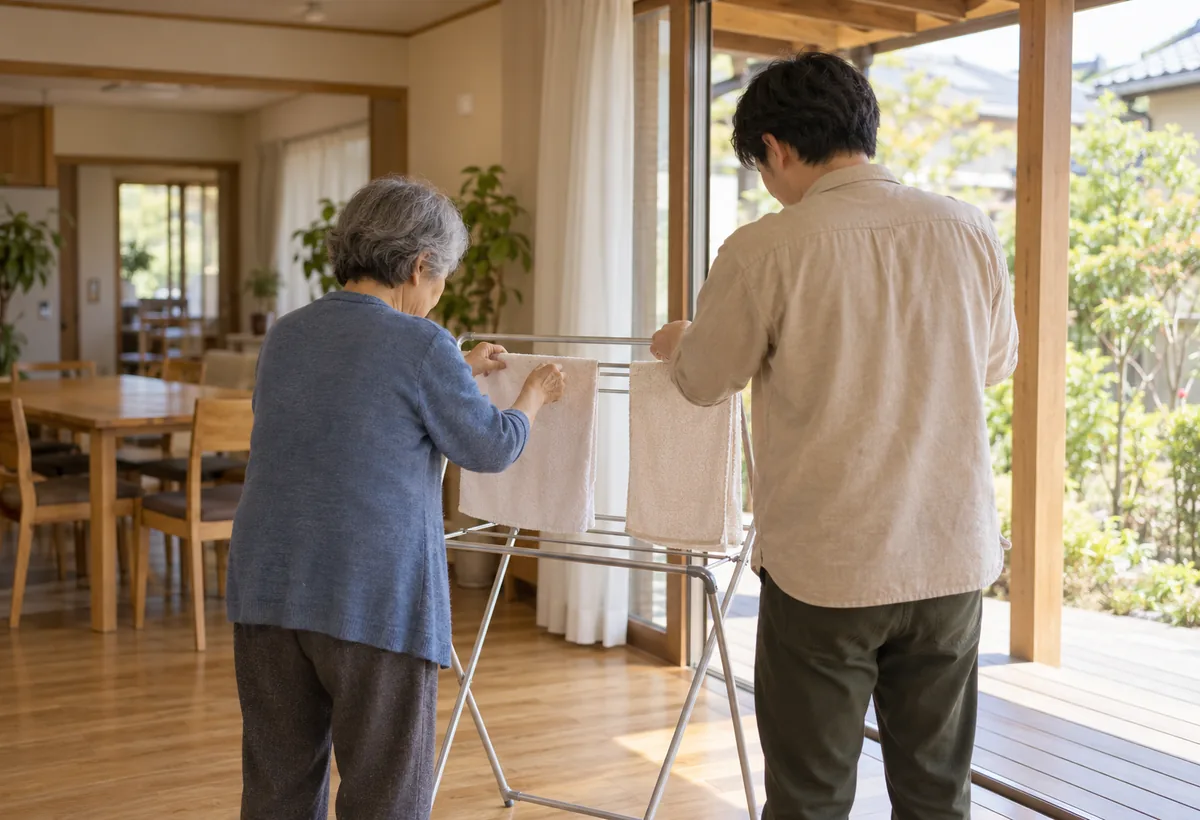
Japan's group homes (guruupu houmu) are dementia care built on a deliberately small scale: units of up to nine residents who share something shaped like household life, with staff cooking alongside residents, laundry hung together, and a routine closer to a home's than an institution's.
The model exists because familiarity and routine are themselves dementia care: in a nine-person house, staff know that Mrs. Sato folds towels when anxious, and the day is built from recognizable domestic acts rather than scheduled programs. The scale is fixed by regulation, not preference: a unit (yunitto) holds five to nine residents and no more, and a single home may run one, two, or at most three of these units side by side, which is why even a large-looking building is really a cluster of small households rather than one floor of beds. Staffing is set to match: during the day the rule is one care worker per three residents counted in full-time-equivalent terms, and at night the general rule is at least one staff member per unit. Qualifying three-unit homes with adjacent units on the same floor and the required safety arrangements may instead use a two-person night shift; ask the home which staffing arrangement applies. The category's formal name, ninchisho taio-gata kyodo seikatsu kaigo, translates roughly as communal-living care for dementia, and the survey count is substantial: 14,341 such establishments were operating nationwide in the 2024 MHLW survey, up 79 (0.6 percent) from the previous year. For many families comparing options after a dementia diagnosis, the group home is the warmest-feeling answer on the list, which makes its two hard constraints (eligibility and geography) worth understanding before falling for one. The wider dementia landscape is covered in our dementia care in Japan article.
Who qualifies, and the same-town rule
Group homes are community-based services (chiiki mitchaku-gata), which produces the constraint that surprises families most: residency. As a rule, the parent must be a registered resident of the same municipality as the home.
The other gates: a dementia diagnosis, and certification at support level 2 or any care level. The cutoff sits exactly there: support level 1 does not qualify, while support level 2 enters through the preventive version of the service and care levels 1 and above through the standard one. Daily life is supported within a small household, but whether the home can admit or continue caring for someone who is bedbound or has substantial medical needs depends on its staffing, medical partnerships and care arrangements. Discuss the parent's actual needs and likely changes with the home rather than treating being bedbound as a blanket exclusion. For a move across municipalities, consult the current insurer, the destination municipality and the home before changing residence. Confirm eligibility, any applicable exception and required procedures; neither eligibility nor a fixed waiting period follows automatically from changing the resident registration. For overseas families whose parent lives in a small municipality, the local supply might be two or three homes total, so the candidate list is short enough to know personally, and the community support center knows them all.
What it costs
Compare each group home’s written monthly charges, entrance payment or deposit, and refund conditions; there is no single price applicable to every home.
The bill includes rent, meals, utilities, and the covered care co-payment. Ichikawa City publishes a reference range of about ¥92,000 to ¥219,000 but does not specify the period; request a written monthly estimate from each home. Two cost behaviors to check in the home's disclosure documents and contract: how charges change as the care level rises, and what the home's policy is on hospitalization absences (whether the room is held and at what cost). A notice that the home is raising its fees is a separate question, covered in handling care home fee increases. The income-based reductions that lower tokuyo bills generally do not apply to group home rent and meals, which is one reason the cheaper-looking tokuyo often wins on price for low-income residents despite the group home's smaller scale. The reason is structural: the burden-limit certification (futan gendogaku nintei) that caps room and meal charges is written for the public nursing-home institutions, and a group home is legally a community-based service rather than one of those institutions, so a pension-only resident who would pay a heavily reduced rate in a tokuyo pays the home's full posted rent here. Municipal schemes must be checked separately. Yokohama, for example, offers assistance with eligible group-home rent, meals and utilities subject to its income and other conditions. Ask the parent’s municipality about the applicable scheme and eligibility rather than assuming national reductions carry over.
The two questions that decide whether it lasts
Group homes do not hold every resident to the end, and the exits are predictable enough to ask about on the first visit.
Medical: group homes are care settings, not nursing ones; a nurse is not necessarily on staff, so conditions needing daily medical procedures can force a move to another facility. Ask specifically which medical needs the home can and cannot hold, and what happened to the last three residents who left. End of life: homes split on mitori (end-of-life care); some see residents through with visiting doctors, others transfer when decline steepens. A home whose answers are concrete on both has thought about it; one that waves at the questions has not. The same exit logic applies as everywhere: a placement that cannot hold the likely trajectory is a two-move plan, and dementia trajectories mostly point one direction.
Waiting, applying, and judging the house
Ask each home about current vacancies, application requirements and how admission priority is decided. Waiting times vary and cannot be inferred from the home’s perceived quality.
Apply early and to several homes at once (allowed and normal), keep the applications warm with updated information, and use the waiting time for day services or small-scale multifunction services that build the parent's tolerance for group settings. Judging the house itself is mercifully concrete at this scale: visit at mealtime, count how many residents are engaged versus parked, watch whether staff talk to residents or about them, and smell the kitchen, because in a real group home someone is cooking. Nine people is small enough that the atmosphere you observe on a Tuesday is the atmosphere your parent will live in.
Frequently asked questions
Who can enter a dementia group home in Japan?
A person with a dementia diagnosis, certified at support level 2 or any care level, who is a registered resident of the same municipality as the home (group homes are community-based services). The community support center knows the local homes and their lists.
How much does a group home cost monthly in Japan?
The monthly total combines the regulated care co-payment with the home’s rent, meals, utilities and other charges, and any entrance payment or deposit must be checked separately, so request the home’s written fee schedule. Tokuyo-style income reductions generally do not apply, so compare against other options at the parent's actual income.
Can a group home care for a resident until the end of life?
It varies by home. Some provide mitori (end-of-life care) with visiting doctors; others transfer residents when medical needs grow, since nurses are not necessarily on staff. Ask each home concretely which conditions it can hold and what happened to recent leavers.
Can we move a parent to a group home near us in another city?
The general rule is use within the municipality where the parent is insured. Before moving, ask the current insurer, destination municipality and home about eligibility, any applicable exception and required procedures. Changing the resident registration alone does not guarantee admission, and timing depends on the individual case and availability.
How Japan Care Concierge can help
A facility search runs as a project, not a list of links. We read each facility's disclosure document, visit in person with a checklist and a camera, and hand back one comparison table with the fee breakdown and exit conditions on it.
Primary and official references
We checked 11 primary or official sources below before writing this article. Rules, costs, and local procedures change by municipality and over time. Confirm the linked official source before a final decision. Last source check: 2026-11-14.
- MHLW: group-home services and regulated care charges (Japanese)
- Yokohama City: local care-service cost assistance (Japanese)
- Hadano City: group-home eligibility and support when care needs increase (Japanese)
- Yokohama City: community-based services and out-of-city insured residents, February 2025 (Japanese)
- MHLW: group-home night staffing and the three-unit exception (Japanese)
- MHLW: Long-Term Care and Welfare Services for the Elderly (Japanese)
- Japanese Law Translation: Long-Term Care Insurance Act
- MHLW: 2024 Survey of Long-Term Care Institutions and Establishments (Japanese, PDF)
- Chouju Net (Foundation for Longevity Science): Dementia group home overview (Japanese)
- MHLW care service information system: dementia group home disclosure items and fee example (Japanese)
- Ichikawa City: Elderly care facility types and monthly cost guide (Japanese)
About this article
This page is general orientation, not medical, legal or individual care advice. Japan Care Concierge is run by Shinkokai, Inc. and draws on the care services of Social Welfare Corporation Shinkou Fukushikai, established in 1999 in the same group, which runs elderly care facilities and services in Kanagawa under the Cross Heart name. We take no referral fees from facilities or providers. We do not provide medical treatment or diagnosis; in an emergency, call 119 first. Hands-on care and guarantor support come through our group companies. Long-term care insurance is run by each municipality or union of municipalities, and each sets its own rules and timelines, so confirm your own case with the municipal long-term care insurance desk or your local community support center. The publication and update dates above are actual dates. How we research, source, and correct content is described in our editorial policy.