
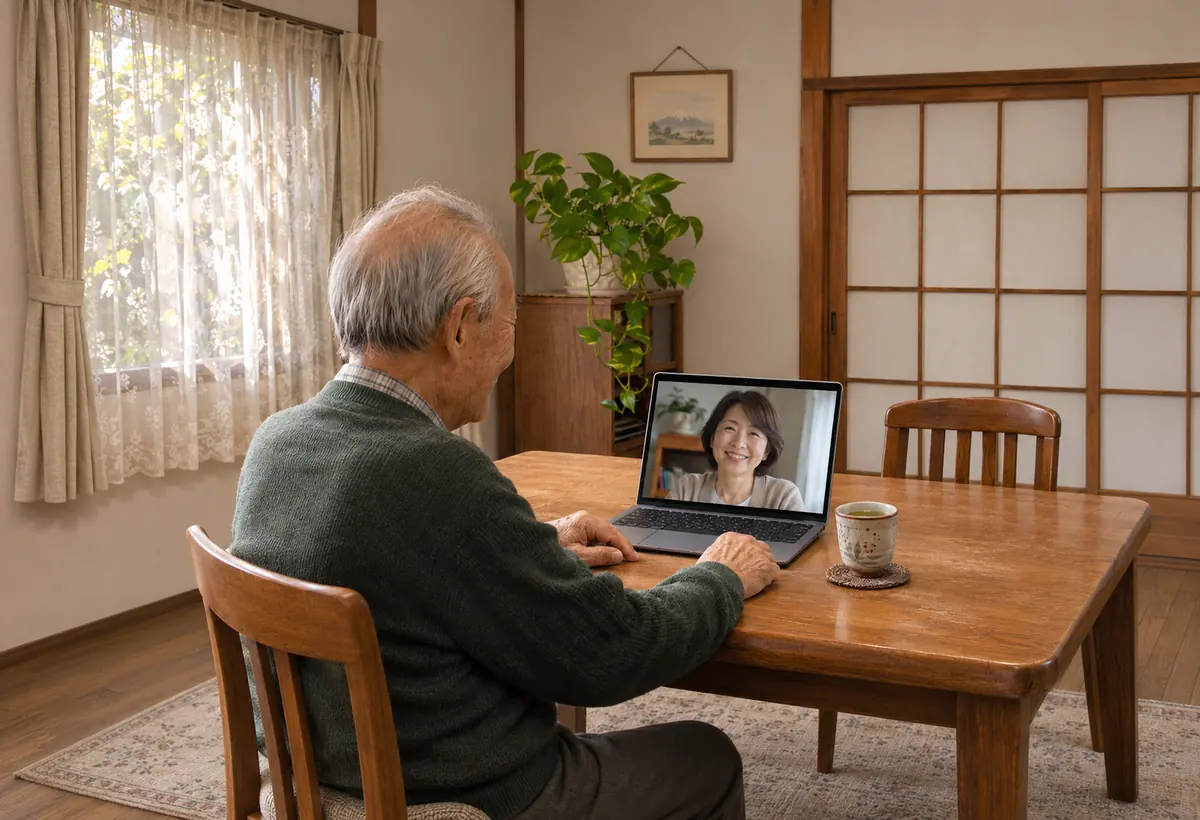
Why isolation is a health problem, not just a sad one
Loneliness in an older parent is easy to file under things that are sad but not urgent. That is a mistake. Sustained social isolation tracks with faster cognitive decline, depression, poorer physical health, and a higher chance that small problems go unnoticed until they become emergencies. Social contact also comes up in what can and cannot lower dementia risk.
Japan has a word for the outcome families fear most: kodokushi, dying alone and undiscovered for days or longer. It is a real and discussed phenomenon here, concentrated among older people who live alone with thin social contact. The point of naming it is not to frighten, but to make clear that connection is a safety measure, on the same level as a handrail or a working smoke alarm, and worth arranging as deliberately.
The scale is now measured rather than guessed. In 2024 Japan's National Police Agency published its first nationwide count of people who died alone at home: 76,020 in that year, and 58,044 of them, more than three-quarters, were aged 65 or over. Kodokushi is not a rare horror story told to frighten; it is a measurable outcome, concentrated among older people living alone with thin contact, which is exactly the situation a parent can drift into from abroad without anyone ever deciding it should happen.
What loneliness looks like from a distance
The hard part for a family abroad is that a parent will almost never say they are lonely. Japanese parents in particular tend to downplay it, partly out of reluctance to worry their children. So you read it indirectly.
- The same few stories on every call, because little new is happening to talk about
- No names of friends, neighbors, or outings mentioned anymore; the social world has quietly shrunk
- Days and nights blurring, meals skipped, less reason to get dressed or leave the house
- More fixation on health complaints or on television, the company that asks nothing back
- Declining invitations and visits, which can be depression rather than preference
- A spouse's death, a move, or giving up driving in the months before; each can collapse a social world fast
Japan's quiet human safety net
Here is what most foreign families do not know: Japan has a layer of people, not just services, whose job includes keeping an eye on older residents. It is uneven and not a substitute for family, but it is real and free.
The most important figure is the welfare commissioner (minsei iin), a local volunteer appointed under national law to watch over residents in a small district, including checking on older people living alone and connecting them to help. There are roughly a quarter of a million of them across Japan. The council of social welfare (shakyo) in each municipality runs friendship salons (fureai ikiiki salon) and other gathering programs, and the community support center coordinates the whole picture. Municipal kaigo yobo classes for older residents are another regular reason to get out. A family abroad can ask the community support center or the municipal welfare desk whether a welfare commissioner covers the parent's area and how to make contact; it is a normal request, not an imposition.
This is also no longer left to volunteers alone. Close to a third of households containing someone aged 65 or over are now single-person households, and the trend prompted a national response: the Act on the Promotion of Loneliness and Isolation Countermeasures took effect in April 2024, putting a Cabinet-level framework and local consultation contacts behind the problem for the first time. For a family abroad the practical upshot is that loneliness is now an official category a municipality is mandated to address, so asking the community support center or the city's loneliness-and-isolation contact what local programs exist is a request the system is now built to answer.
| Who | What they do | How a family abroad reaches them |
|---|---|---|
| Welfare commissioner (minsei iin) | Local volunteer appointed under national law who checks on and visits isolated older residents and links them to help; roughly a quarter of a million nationwide | Ask the parent's city or ward welfare desk for the commissioner covering the parent's address |
| Friendship salon (fureai ikiiki salon) | Drop-in gatherings for connection and activity, run by the municipal council of social welfare | Contact the council of social welfare (shakyo) in the parent's municipality |
| Community support center (chiiki houkatsu shien center) | The public one-stop hub for elder care, monitoring, and welfare coordination | The city or ward hall names the center covering the parent's address |
What the national survey shows
The Cabinet Office's 2025 national survey asked people aged 16 or over how often they feel lonely. Among people who live alone, 6.3 percent of those in their seventies (443 respondents) and 5.1 percent of those aged 80 or over (314) answered often or always. Among people who live with others, the figures were 1.5 percent (1,839) and 2.2 percent (896).
The survey was sent to 20,000 people drawn at random from the resident register, with a reference date of December 1, 2025, and 11,873 valid responses (59.4 percent). Overall, 4.5 percent said they feel lonely often or always. People in their seventies (2.5 percent) and aged 80 or over (3.0 percent) were below the overall rate, and people in their thirties to fifties were higher, at about 6 percent.
The survey reports shares of respondents and does not show cause and effect. Its figures on going out and on talking with people are for all ages, so they describe a general pattern and say little about one parent. Use them to know what to look for, and treat your parent's own answers and daily routine as the real evidence.
Local governments and the 2024 law
The Act on Promotion of Policy for Loneliness and Isolation took effect on April 1, 2024. Article 4 gives local governments a duty to design and carry out measures that fit conditions in their area, and Article 15 asks them to make an effort to set up a regional council of related agencies and groups, which exchanges information and discusses support under Article 16.
Because setting up a council is an effort obligation, whether your parent's city has one varies. Some cities also sign agreements with local businesses. Funabashi City in Chiba lists 35 cooperating organizations and businesses (as of April 1, 2026), including newspaper, food delivery, gas, postal and convenience store partners, who report anything unusual they notice to the city.
Funabashi asks residents who will be away from home for travel, a hospital stay or a move to a facility to stop newspaper and meal deliveries in advance, and to tell delivery companies a relative's emergency contact. That is one city's practice. Ask the parent's community support center or the elder welfare desk whether the city has something similar.
Gathering places across Japan
The Ministry of Health, Labour and Welfare counted 162,946 community gathering places (kayoi no ba) run for care prevention in fiscal 2024. Participants equal 6.9 percent of the population aged 65 or over, and 2.7 percent attend places that meet at least weekly.
Of the 1,741 municipalities that answered, 1,713 had gathering places, and exercise was the most common activity. Only places that meet at least once a month are counted. For a parent who has stopped going out, ask the community support center or the city's long-term care desk where the nearest place is, which days it meets and how to join. A small first contact, such as a delivery handover or a greeting from a neighbor, is a gentler start than pressing for the salon.
Building connection back, gently
Isolation rarely reverses on its own, but it responds well to a few deliberate threads of contact, layered so that no single one carries all the weight.
- A fixed-rhythm call from family, valued as connection rather than a check-up, at a time the parent looks forward to
- A reason to leave the house weekly: a salon, a day service, a class, a temple or shrine routine, a standing errand
- One or two local human contacts who see the parent in person, whether a neighbor, a relative, or a befriending volunteer
- Companion or sitter visits where unpaid contact is thin, covered in our article on elderly companion services
- A role, however small: tending plants, a pet, a task others rely on; purpose protects against isolation as much as company does
Where monitoring fits, and where it does not
Technology has a place here, but it solves a different problem than loneliness. A sensor tells you a parent has not moved today; it does not give them a reason to.
Treat the two as separate layers that work together. Monitoring and emergency-call systems, covered in our guide to elderly monitoring in Japan, reduce the risk of an unnoticed crisis and ease a distant family's mind. Human connection reduces the loneliness itself. A parent who is watched by sensors but seen by no one is safer than before and no less alone. The goal is both: a safety net that catches a fall, and a social fabric that makes the days worth getting up for. For the wider picture of a parent on their own, see our article on an elderly parent living alone in Japan.
The police data also quantified why the watching layer matters. Among older people who died alone at home, the most common case was discovery within a day, but a long tail were not found for a month or more, over 4,500 of them in a single year. That gap is almost entirely a function of whether anyone, or anything, was checking. A monitoring layer compresses the tail toward hours; human contact works further upstream, lowering the odds of the isolated death in the first place. That is the concrete reason the two layers are worth paying for together rather than choosing between.
Frequently asked questions
What is kodokushi, and how worried should a family be?
Kodokushi is the Japanese term for dying alone and going undiscovered for an extended time, concentrated among older people who live alone with little social contact. It is a real phenomenon worth planning against, not by panicking but by building regular human contact and a monitoring layer, so that both loneliness and the risk of an unnoticed crisis are addressed.
Who checks on elderly people living alone in Japan?
Each district has a volunteer welfare commissioner (minsei iin), appointed under national law, whose role includes watching over and visiting isolated older residents and linking them to help, with about a quarter of a million nationwide. The council of social welfare runs friendship salons, and the community support center coordinates. Families can ask the support center how to make contact.
How can I tell if my parent in Japan is lonely when I live abroad?
Parents rarely say it, so read it indirectly: a shrinking social world with no friends or outings mentioned, the same few stories each call, skipped meals, blurred days, fixation on health or television, and declining visits. A recent loss, a move, or giving up driving can collapse a social world quickly and is worth watching for.
Does a monitoring device fix an elderly parent's loneliness?
No. Sensors and emergency-call systems reduce the risk of an unnoticed crisis, but they do not give a parent connection or a reason to engage with the day. Treat monitoring and human contact as separate layers that work together: one catches a fall, the other addresses the isolation itself, and an older parent needs both.
Are older people who live alone lonelier than those who live with family?
In the Cabinet Office's 2025 survey, people in their seventies or aged 80 or over who live alone were more likely to say they feel lonely often or always than those who live with others. The survey shows group shares, not the state of one person, so check your parent's calls, outings, meals and mail as well.
Can a local government help prevent a lonely death?
Sometimes. Many cities offer emergency call devices or meal delivery, and some have agreements with businesses that report anything unusual they notice. The 2024 loneliness act also asks local governments to set up regional councils where they can. What exists depends on the city, so ask the community support center or the elder welfare desk where your parent lives.
How Japan Care Concierge can help
We are the pair of hands in Japan while you sleep. Calls to the municipal office and the care manager happen inside Japanese business hours, and the written English summary is waiting when you wake up.
Book a free 30-minute consultationHow we work with families abroad
Primary and official references
We checked 7 primary or official sources below before writing this article. Rules, costs, and local procedures change by municipality and over time. Confirm the linked official source before a final decision. Last source check: 2026-11-15.
- National Council of Social Welfare: welfare commissioners (Japanese)
- MHLW: what welfare commissioners and child welfare volunteers do (Japanese)
- National Police Agency: people who died alone at home, 2024 (Japanese)
- Cabinet Office: Act on Promotion of Loneliness and Isolation Countermeasures (Japanese)
- Cabinet Office: national survey on loneliness and isolation 2025, summary (PDF, Japanese)
- Funabashi City: community monitoring network (Japanese)
- MHLW: survey on community gathering places and care prevention, fiscal 2024 (PDF, Japanese)
About this article
This page is general orientation, not medical, legal or individual care advice. Japan Care Concierge is run by Shinkokai, Inc. and draws on the care services of Social Welfare Corporation Shinkou Fukushikai, established in 1999 in the same group, which runs elderly care facilities and services in Kanagawa under the Cross Heart name. We take no referral fees from facilities or providers. We do not provide medical treatment or diagnosis; in an emergency, call 119 first. Hands-on care and guarantor support come through our group companies. Long-term care insurance is run by each municipality or union of municipalities, and each sets its own rules and timelines, so confirm your own case with the municipal long-term care insurance desk or your local community support center. The publication and update dates above are actual dates. How we research, source, and correct content is described in our editorial policy.