
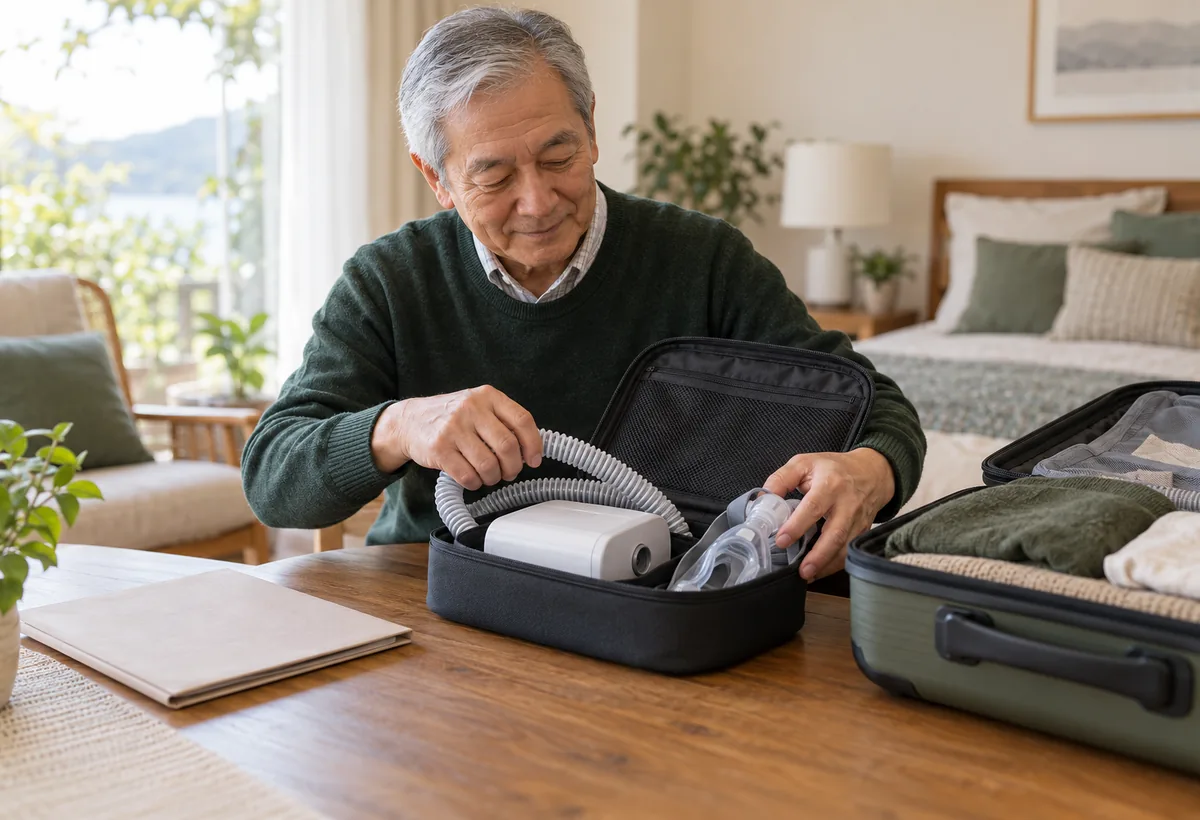
Powered devices travel, but each needs setting up first
An older traveler who depends on supplemental oxygen, a CPAP machine, or another powered medical device can still come to Japan. What changes is that each device carries three separate questions, the airline's rules, Japan's customs rules, and whether it will run on Japanese power, and all three are settled before departure rather than discovered at the gate.
This is the navigator's checklist for that setup. It is general orientation, not medical or airline advice; the device's own doctor and the specific airline have the final word, and their requirements differ enough that confirming directly is part of the job.
Device self-check
Answer these for each device before the flights are paid for. Every "no" points to one of the sections below, and most of them have a deadline set by the airline or the rental company. If you would rather hand the Japan side to someone who works in Japanese, you can ask us about the trip.
- Has the parent's doctor agreed to the trip, and completed the airline's medical form if oxygen will be used in flight?
- Is the concentrator a model the airline accepts, with batteries for about 150 percent of the flight time?
- Does the label on each device and charger read 100 volts, or a range such as 100 to 240 volts?
- If oxygen is needed in Japan, is a rental booked with delivery to the first hotel?
- Is each device a single set for the traveler's own use, which customs treats as personal?
- Does any medicine packed for the trip run past a one-month supply, which would need an import confirmation?
Portable oxygen concentrators on the flight
A portable oxygen concentrator (POC), which makes oxygen from cabin air, is the form of in-flight oxygen airlines most often allow, but only with advance clearance.
On a major Japanese carrier, a passenger planning to use a POC submits an airline medical form completed by their physician ahead of travel, and the device must be an approved model, typically one labeled as meeting the US FAA acceptance criteria. The battery rule is the part travelers underestimate: carry enough fully charged batteries for about 150 percent of the expected flight time, because the seat power outlet cannot be relied on to recharge a POC in flight. Spare lithium batteries are dangerous goods that must be in the cabin and declared. Cabin crew cannot operate the device for you, so the traveler or a companion must be able to run it, and if it will not fit under the seat in front, the airline may require buying an adjacent seat. One distinction matters: a POC is treated very differently from compressed-gas or liquid oxygen cylinders, which are far more restricted. Confirm your exact model, batteries, and the notice deadline with your own airline well before booking. If the flight is a one-way move rather than a holiday, medical clearance and escorts for a parent's relocation flight walks through the rest.
Arranging oxygen within Japan
Oxygen at the destination is a separate arrangement from the flight, and it is not something a visitor buys on arrival.
Medical oxygen in Japan is normally prescription-based, supplied through providers in the same way the domestic home-oxygen system works. A visitor arranges rental in advance through a service that handles international patients, providing a doctor's prescription (an English one is accepted by at least one provider), completing a medical note and rental agreement, and paying before arrival in Japan. Lead time is real: one visitor-facing provider asks for bookings roughly a month to ten days ahead and charges steep cancellation fees close to the date. Both portable and stationary units can be rented, and the prescribed flow rate decides which is suitable, so the spec is coordinated between the traveler's doctor and the provider, and delivery to the accommodation is arranged in advance. In short, treat oxygen supply in Japan as a coordination task to finish before the trip, not a stop to make during it.
CPAP, and Japan's 100-volt reality
A CPAP machine is the easiest of these devices to travel with, but Japan's power supply trips up travelers who do not check it.
A CPAP is a medical device and is generally allowed in the cabin; under common air-travel rules it does not count against the carry-on or baggage allowance when carried in its own case. Notify the airline in advance if you intend to use it in flight, keep any lithium batteries in carry-on, and bring a doctor's letter or prescription, ideally with a translated note, to smooth screening and customs. The Japanese-power step is the one to get right: mains power in Japan is 100 volts with Type A plugs. Read the label on the machine's power supply; if it says input 100 to 240 volts, as most modern units do, you only need a plug adapter, not a voltage converter. If the unit is single-voltage, you would need a converter. Plan the humidifier water too, since distilled water, which CPAP humidifiers want rather than tap water, is harder to find casually in Japan, so bring a supply or choose waterless humidification for the trip.
Customs: personal devices are fine, large quantities are not
Bringing a personal medical device through Japanese customs is straightforward at normal personal quantities.
The health ministry (MHLW) lets a traveler bring one set of a household-use medical device for personal use with no import confirmation. A single CPAP or POC for the traveler's own use sits inside that. Larger quantities can require an import confirmation (the yakkan shoumei, now issued as the yunyu kakunin-sho), applied for through MHLW's online system and received before leaving home, and a device and medication can be combined on one application. Medicines have their own limits: up to a one-month supply of prescription medicine, and up to a one-month supply of injectables in pre-filled syringe or self-injection kit form, need no procedure. Our guide to bringing medications to Japan explains the rest. When a device or quantity is borderline, the accurate move is to ask the health ministry's regional bureau before travel and declare the device on arrival rather than guess.
The practical plan, and where families get help
Pulled together, the device traveler's pre-trip list is short but unforgiving of being left late.
Declare powered devices to the airline early and submit any oxygen clearance form well ahead; carry the doctor's letter and a translated note; keep the device and all lithium batteries in carry-on; verify the 100-volt fit and pack the right adapter; and have a backup plan for a power cut, including spare batteries and a confirmed delivery for any rented oxygen. For an overseas family, the hard part is doing all of this in Japanese and on a clock, which is the layer an in-country coordination service is built for, alongside the wider care-aware travel support for the rest of the trip. A traveler on dialysis has a parallel arrangement to set up, covered in our holiday dialysis guide, and the general what-if is in our article on getting sick while visiting Japan.
Frequently asked questions
Can I bring a portable oxygen concentrator on a flight to Japan?
Usually yes, with advance clearance. Airlines require a physician-completed medical form ahead of travel, an approved (typically FAA-labeled) model, and enough batteries for about 150 percent of the flight time, since in-seat power cannot be relied on to recharge it. Compressed-gas or liquid oxygen cylinders are far more restricted. Confirm the model, batteries, and deadline with your own airline.
Can I use my CPAP machine in Japan?
Yes. Carry it in the cabin in its own case (it usually does not count against your baggage allowance), notify the airline if using it in flight, and carry a doctor's note. Japan's power is 100 volts with Type A plugs, so check the machine's label: if it reads 100 to 240 volts you only need a plug adapter, not a converter. Plan a distilled-water source for the humidifier.
How do I get oxygen in Japan as a visitor?
Arrange it in advance, not on arrival. Medical oxygen in Japan is prescription-based, so a visitor rents equipment through a provider that handles international patients, supplying a doctor's prescription, completing a rental agreement, and paying before arrival, often booking a month to ten days ahead. Delivery to the accommodation is arranged in advance.
Do medical devices need customs paperwork in Japan?
Not for normal personal use. MHLW allows one set of a household-use medical device for your own use with no import confirmation, so a single CPAP or oxygen concentrator is fine. Larger quantities need the import confirmation (yakkan shoumei), which can be combined with a medication application and must be received before you fly. Declare the device to customs on arrival.
How Japan Care Concierge can help
The first consultation is 30 minutes and free. You leave it with a sequence: which office to contact first, what to prepare, and what your family abroad needs to see.
Primary and official references
We checked 5 primary or official sources below before writing this article. Rules, costs, and local procedures change by municipality and over time. Confirm the linked official source before a final decision. Last source check: 2026-10-18.
- ANA: customers using a portable oxygen concentrator (English)
- MHLW: information for those bringing medicines and medical devices for personal use into Japan (English)
- Japan Customs: private importation of drugs, cosmetics and medical devices (English)
- FAA: acceptance criteria for portable oxygen concentrators
- Sleep Foundation: does a CPAP machine count as a carry-on?
About this article
This page is general orientation, not medical, legal or individual care advice. Japan Care Concierge is run by Shinkokai, Inc. and draws on the care services of Social Welfare Corporation Shinkou Fukushikai, established in 1999 in the same group, which runs elderly care facilities and services in Kanagawa under the Cross Heart name. We take no referral fees from facilities or providers. We do not provide medical treatment or diagnosis; in an emergency, call 119 first. Hands-on care and guarantor support come through our group companies. Long-term care insurance is run by each municipality or union of municipalities, and each sets its own rules and timelines, so confirm your own case with the municipal long-term care insurance desk or your local community support center. The publication and update dates above are actual dates. How we research, source, and correct content is described in our editorial policy.