
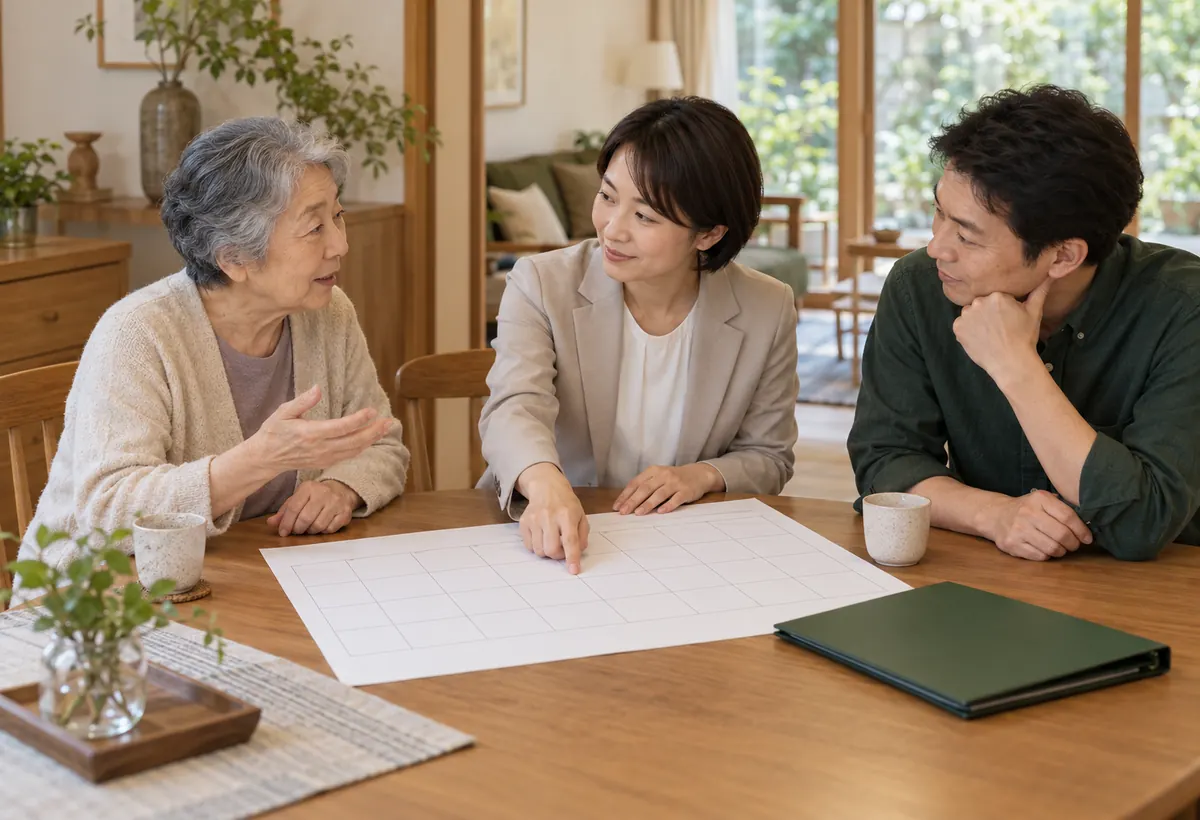
A care manager in Japan (kea mane, formally kaigo shien senmonin) is a licensed coordinator who writes the care plan after certification, books the providers, and visits a parent at home once a month. For a parent living at home, the family pays nothing for this work. Care managers in Japan help connect certified care needs to a care plan and service coordination. Families should understand their role, boundaries, and what information to prepare before meetings. Families do not have to track one down alone: a municipality keeps a public list of home-care support offices (kyotaku kaigo shien jigyousho) for its area, and the local community support center will introduce one, so the practical first step is to request that municipal list or ask the center, then pick an office that fits.
Care managers turn needs into a care plan
A care manager helps coordinate a care plan based on the person's certified care needs, daily life, provider availability, and local care system. The care plan is the practical bridge between assessment and services.
Three structural facts orient the relationship, and the community support center can introduce a care manager once certification exists. Care management carries no user charge — planning, provider coordination, and monitoring are covered in full by the long-term care insurance system. The family chooses the care manager, by selecting a home-care support office (kyotaku kaigo shien jigyousho) from municipal or community-support-center listings, and can change offices later, as long as the new office files the change notification with the municipality on time. And the role runs on a monthly rhythm: a home monitoring visit, plan adjustments as needs shift, and renewals alongside recertification, which means the care manager sees the person at home more often than most distant relatives do. That monthly visit is not a courtesy but a legal duty of the home-care support office: under the national operating standards for these offices, the care manager must meet a certified user face-to-face at the user's own home at least once a month and record the result of that monitoring each month, so a parent at home is seen by a professional roughly twelve times a year. The same standards require the office to convene a service-coordination meeting (sabisu tantosha kaigi) when the plan is first built, bringing the providers, the family, and the care manager to the same table so goals and responsibilities are agreed together rather than assumed separately. Two practical consequences follow for families. The care manager becomes the household's single point of coordination across every provider on the plan, the one person who holds the whole picture and can adjust one service without the family chasing each provider individually. And the work is paid in a way that surprises families used to co-payments: while most covered services charge the user 10 to 30 percent, home-care support itself is reimbursed to the office at 100 percent by long-term care insurance, so the planning, the coordination, and the monthly monitoring generate no invoice and no co-payment for the family at all. Timing matters too, because services often need to begin before the certification result is issued. Japanese municipalities allow a provisional plan (zantei care plan) for exactly this gap: once an application is filed, the care manager can build a plan against the expected care level so that day service or home help can start immediately, with the formal plan finalized once the result arrives. It is worth understanding what the care manager actually produces. The standard home-care service plan document (kyotaku service keikakusho) is not a vague summary but a structured record: an assessment of the person's situation and the life problems to be solved, long-term and short-term goals, a week-by-week service schedule that names the specific provider office, frequency, and time slot for each service, and a periodic monitoring entry. Asking for a plain-language walkthrough of these pages tells an overseas family precisely who is doing what, when, and toward which goal. A page-by-page guide to those documents is in how to read your parent's Japanese care plan.
Who plans which care
Which care manager a parent gets depends on the certified level and on where the parent lives. Home-care support offices (kyotaku kaigo shien jigyousho) serve people at home with a care level of 1 to 5. Lighter support levels and facility residents follow different routes.
For the lighter levels, see what a support-level certification gives you. For the move from home to a facility, see home care versus facility care.
| Parent's situation | Who writes the plan | Where the family asks |
|---|---|---|
| At home, care level 1 to 5 | A care manager at a home-care support office the family chooses | The municipal list of offices, the community support center, or the national search site |
| At home, support level 1 or 2 | The community support center, or a home-care support office working with it | The community support center for the parent's address |
| In a nursing home, geriatric health facility, or care-included paid home | The facility's own care manager | The facility |
| Using small-scale multifunctional home care | That provider's own care manager | The provider |
How to find one
Families usually choose a home-care support office soon after the certification result arrives. If services must start earlier, an office can begin with a provisional plan once the application is filed.
Offices near the parent's home are easier to work with, because the monthly visit happens there. If the parent was in hospital, the hospital's medical social worker often suggests offices at discharge. The family can still choose a different one.
- Ask the municipal long-term care desk for its list of home-care support offices, or ask the community support center to introduce one
- Search the MHLW Care Service Information Disclosure System (kaigokensaku) for the service type kyotaku kaigo shien in the parent's area
- Call two or three offices and ask whether a care manager has room for a new case
- Ask how they keep families informed (phone, email, or a messaging app) and whether they have worked with relatives abroad
- Once an office agrees, it usually files the care-plan request notification with the municipality, together with the parent's insurance card
Care manager qualifications
A care manager is not an entry-level job. Under the MHLW rules for the prefectural exam, candidates need at least five years and 900 days of work in a listed national qualification or in specified consultation roles. The listed qualifications include doctor, nurse, certified care worker, social worker, and physical or occupational therapist.
After passing the exam, candidates complete practical training and register with the prefecture, which issues the care manager certificate (kaigo shien senmonin sho). The exam is selective. In the 28th exam in October 2025, 12,961 of 50,601 candidates passed, a rate of 25.6 percent. Some municipalities ask the office for a copy of this certificate or a staff ID when it files the care-plan request. Asking to see it is a normal question.
The license renewal rule is changing. Until now the certificate has been valid for five years, and renewal required a fixed renewal training course of 32 hours for second and later renewals. The Act Partially Amending the Social Welfare Act and Related Laws (Act No. 51 of 2026, promulgated on June 25, 2026) abolishes this training-based renewal. MHLW's summary says that once issued, the certificate will no longer lapse on a date. Periodic training continues in a more flexible form, and employers must take steps, such as freeing up time, so their care managers can attend.
This part of the law starts on a date set by Cabinet Order within 18 months of promulgation. Until that date, the current five-year renewal still applies. For families nothing changes in how the care manager works for the parent.
What it costs
For a parent living at home, care management is free to the user today. Long-term care insurance pays the home-care support office in full, so there is no 10 to 30 percent co-payment for the plan, the coordination, or the monthly visit.
Of the reported plans to charge for care planning, only the third row has been written into law. The 2026 law creates registration for paid homes that take residents with moderate to heavy care needs. It also adds a new planning service for residents of registered residential-type homes, charged in principle at 10 percent to match care-included homes. It does not charge people who live in their own homes, and the Diet's supplementary resolutions ask the government to treat care management for home-service users with caution. Details and start dates are still being set by cabinet and ministerial orders, so confirm with the municipality before relying on them.
| Setting | User charge | Status |
|---|---|---|
| At home, home-care support office | None | Current rule |
| Nursing home or care-included paid home | Part of the facility service fee, with the usual 10 to 30 percent co-payment | Current rule |
| Residential-type paid home registered under the new system | A charge, in principle 10 percent, for a new planning service for residents | Created by Act No. 51 of 2026; not yet in force, start date still to be set |
Changing care managers
A family can change care managers. Services already in the plan usually continue, but when the office changes the new office must file a notification with the municipality, and a late filing can mean paying the full cost first until the claim is sorted out. The steps are in how to change your care manager in Japan.
Municipal rules on the notification differ. In Setagaya, Tokyo, the ward requires a notification whenever the office changes, and again when a parent moves between a support level and a care level, even with the same office. The ward also sets a monthly deadline: a notification that arrives late means the next month's insurance claim is returned. Ask the new office to confirm the filing date so the switch lands in a clean month.
- To change the person only, ask the office for a different care manager on its staff
- To change the office, contact a new office directly or ask the community support center for options
- The new office files a care-plan request change notification with the municipality, with the insurance card attached
- Tell the old office the end date so the plan and provider bookings carry over
The care manager is not every role
A care manager may coordinate care services, but families may still need separate support for medical appointments, translation, facility comparison, private services, family reporting, or overseas decision-making; our article on working with a care manager as a foreign family covers that layer in detail, and our care navigation service and support for families abroad exist to hold exactly the parts the care-manager role cannot.
Knowing the boundary prevents two common frustrations: expecting the care manager to interpret, report in English, or manage family logistics (not the role), and underusing what the role does offer — deep knowledge of local providers, fast plan adjustments after hospitalizations, and an experienced read on whether home support is reaching its limits.
Preparation makes meetings better
Bring a clear picture of daily life: specific examples make planning more accurate, and the care manager plans from what the family provides.
- Daily function: mobility, bathing, toileting, meals, sleep, housework
- Medical: medications, conditions, doctors, recent hospitalizations
- Incidents with dates: falls, medication errors, confusion episodes
- The week's hardest hours, including nights and weekends
- Who helps locally, and what the family realistically can and cannot do
- For foreign families: language needs and a translated key page
Overseas families should define communication rules
If key relatives live abroad, clarify who receives updates, who approves costs, who joins meetings, and what situations require immediate escalation. This prevents confusion when care needs change.
Put it in writing, in Japanese, one page, and hand it over at the first meeting. The default failure mode without it: the care manager calls whichever relative answers, decisions drift toward the most reachable person rather than the agreed one, and the overseas family learns of changes after the fact. The monthly monitoring visit is also an underused asset for distant relatives — a short note after each visit, or an occasional video-call join, effectively adds a professional observer to the family's reporting rhythm; ask early, while goodwill is being established.
Review the plan when life changes
Hospital discharge, falls, cognitive changes, caregiver burnout, or home safety problems can require a plan review. Families should document changes and ask how reassessment or care-plan changes work locally. What happens to services already running when a parent is admitted is set out in care services during a hospital stay.
Two review tracks exist and families should know both: the care plan itself can be adjusted quickly, care managers do this routinely after hospitalizations, while the certified level changes through reassessment, which can be requested early when needs shift materially. And when the care manager starts saying, however softly, that home support is reaching its limit, treat the words as data from someone who has watched this trajectory many times: it is the cue to start facility research while there is still time to choose. Certification renewal is the third moment families should mark on the calendar, because the care manager carries a defined role there too. When the certified care level is renewed or formally changed through a reassessment of the care-need classification, the operating standards require the office to reconvene a service-coordination meeting and re-examine the plan against the new level, rather than carry the old plan forward by habit. For an overseas family this renewal cycle is a built-in checkpoint: a natural point to confirm the plan still matches the parent's real daily life, to surface anything that has quietly drifted since the last review, and to ask the care manager for a plain summary of what changed in the plan and why. Treating each renewal as a scheduled review, not a paperwork formality, keeps distant relatives synchronized with a situation that rarely stands still.
What the free care manager covers, and where we help
Japan's system is built around a care manager who runs coordination at no charge to the family, and for most households that is the right place to start. The role is genuinely thorough: the plan, the monthly visits, and the provider coordination are all covered by long-term care insurance. Japan Care Concierge steps in only for the parts that sit outside that role, the work a care manager is neither paid nor positioned to do. Here is where the line falls:
If your parent already has a capable care manager and your family simply needs the overseas-facing layer on top, that is exactly the gap we are built to fill.
| What the care manager covers (free, insurance-funded) | When to involve Japan Care Concierge |
|---|---|
| Builds and maintains the care plan, coordinates every provider, and holds the whole picture as the household's single point of contact | Reads that plan back to overseas relatives in English or another language, with a short written update after each monthly visit so distant family stays current |
| Arranges services covered by long-term care insurance and adjusts them as needs change | Sources and books private-pay help insurance will not fund: extra home hours, escort to appointments, and shopping or housekeeping beyond the covered hours |
| Shares facility information and coordinates when home support reaches its limit | Runs the final facility comparison with the family, visiting shortlisted homes, weighing cost against fit, and walking you through contracts before you sign |
| Plans care from what the family reports, and meets the parent at home about monthly | Handles money and decision logistics from afar, and helps siblings reach a shared decision when relatives disagree about cost or direction |
Frequently asked questions
How much does a care manager cost?
Nothing extra. Care management is covered in full by long-term care insurance, with no user co-payment for planning, coordination, or monthly monitoring. In a nursing home or care-included paid home, planning is part of the facility fee instead.
Can families choose or change their care manager?
Yes. Families select a home-care support office after certification and can switch later. Services in the plan usually continue, provided the new office files the change notification on time. Choose for fit: communication style, responsiveness, and experience with situations like yours, including overseas decision makers.
Can a care manager speak English?
Some may, but families should not assume English support. Written Japanese summaries and clear questions can help when language support is limited.
Does a care manager choose a facility for the family?
A care manager may provide information and coordination, but final decisions and contracts should be confirmed by the family with each provider or facility.
When does a family usually meet a care manager?
Often after local procedures and care-need certification, though families may first need guidance from a municipality or community support center.
Does a Japanese care manager's license expire?
Under the current rule the certificate is valid for five years and renewed through training. Act No. 51 of 2026 abolishes that training-based renewal from a date set by Cabinet Order within 18 months of June 25, 2026. After that, an issued certificate no longer lapses on a date, though periodic training continues.
What paperwork is involved in switching care-management offices?
The new office files a care-plan request change notification with the municipality, usually with the insurance card attached. Forms and monthly deadlines differ by municipality, so ask the new office to confirm the filing date.
How Japan Care Concierge can help
The first consultation is 30 minutes and free. You leave it with a sequence: which office to contact first, what to prepare, and what your family abroad needs to see.
Primary and official references
We checked 14 primary or official sources below before writing this article. Rules, costs, and local procedures change by municipality and over time. Confirm the linked official source before a final decision. Last source check: 2026-11-01.
- Japanese Law Translation: Long-Term Care Insurance Act
- MHLW: Long-Term Care and Welfare Services for the Elderly (Japanese)
- MHLW: operating standards for designated home-care support (Ministerial Ordinance; Japanese)
- MHLW Care Service Information Disclosure System: how home-care support is paid (Japanese)
- MHLW: standard home-care service plan form and recording guidelines (Japanese, PDF)
- Nagaokakyo City: provisional care plan (zantei care plan) handling (Japanese, PDF)
- MHLW: summary of Act No. 51 of 2026, including the end of care manager renewal and the new planning service for registered paid homes (Japanese, PDF)
- MHLW: report on Act No. 51 of 2026 with the Diet supplementary resolutions, LTC Insurance Subcommittee, June 29, 2026 (Japanese, PDF)
- MHLW: notice of promulgation of Act No. 51 of 2026, June 25, 2026 (Japanese, PDF)
- MHLW: bills submitted to the 221st Diet session (Japanese)
- MHLW: implementation notice for the care manager practical-training exam, eligibility (Japanese)
- MHLW: results of the 28th care manager exam (Japanese)
- MHLW Care Service Information Disclosure System: search for providers (Japanese)
- Setagaya Ward, Tokyo: care-plan request and change notification (Japanese)
About this guide
This page is general orientation, not medical, legal or individual care advice. Japan Care Concierge is run by Shinkokai, Inc. and draws on the care services of Social Welfare Corporation Shinkou Fukushikai, established in 1999 in the same group, which runs elderly care facilities and services in Kanagawa under the Cross Heart name. We take no referral fees from facilities or providers. We do not provide medical treatment or diagnosis; in an emergency, call 119 first. Hands-on care and guarantor support come through our group companies. Long-term care insurance is run by each municipality or union of municipalities, and each sets its own rules and timelines, so confirm your own case with the municipal long-term care insurance desk or your local community support center. The publication and update dates above are actual dates. How we research, source, and correct content is described in our editorial policy.