
About costs: figures in this article are estimates as of the source check date (2026-11-14). Care covered by long-term care insurance is billed at official rates, whatever language it is delivered in. Interpreting, translation and other services outside insurance, and fees a facility sets itself such as rent, can be charged on top. Hospitals may also charge an interpreter fee after explaining it in advance. Check the fee section of the contract summary (juyo jiko setsumeisho) before signing.
In-home care starts with the home itself
Before comparing providers, review the home environment: much of what gets labeled a 'care need' is really a home-design problem with a cheaper fix.
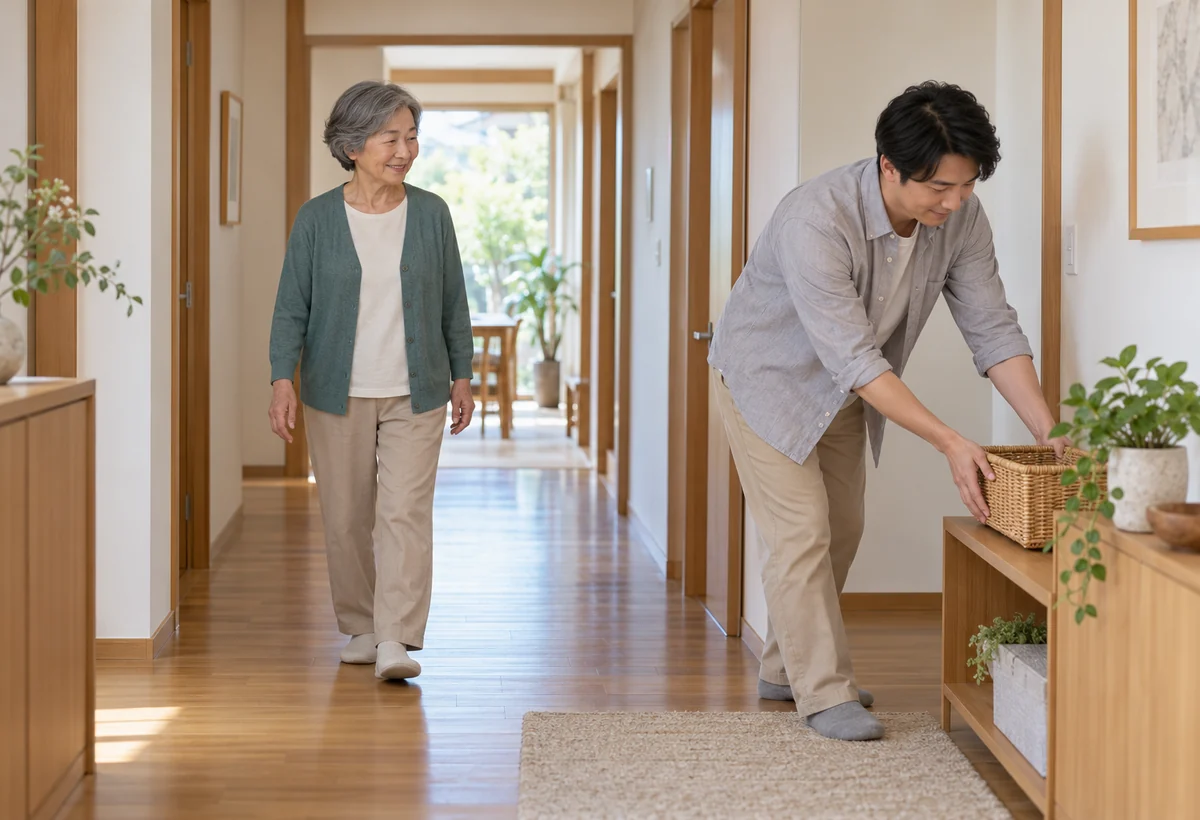
Walk the home like an assessor: entrance steps, stair lighting and rails, bathroom grab points and water temperature, kitchen fire risk, trip hazards, the night route to the toilet, and how the parent would summon help after a fall. Long-term care insurance helps here more than families expect: covered equipment rental runs from hospital beds and walkers to rails, and home-modification benefits cover eligible work such as handrails and step elimination. The standard eligible-cost limit is ¥200,000 per insured person, with insurance paying 70–90 percent according to the person’s co-payment rate. Reuse exceptions can apply after moving or a qualifying increase in care need. Consult the care manager and municipality and apply before work begins.
How much help does your parent actually need?
Before booking anything, gauge the level of help honestly. Japan's care-need certification measures this formally, but a family can sketch it in an afternoon, and the sketch decides which services to ask for and how urgent the application is.
Write dated, concrete examples against each line. They are exactly what the certification assessor and care manager plan from, and they turn a vague worry into a level of need. Record difficulties and night-time safety risks for the assessor and care manager; a count of affected tasks alone cannot determine the certified level or service schedule. The care levels guide explains what each certified level unlocks, and a short assessment visit may not show every daily difficulty. Our guide to the assessment-day interview covers what to write down beforehand.
- Mobility: can they walk, climb stairs, and rise from a chair or bed unaided, or has a fall already happened?
- Bathing and toileting: managed alone, managed with grab bars, or needing another person?
- Meals: cooking real meals, living on the same few bought items, or skipping meals and losing weight?
- Medication: taken correctly, or missed, doubled, or left expired in the cabinet?
- Cognition and safety: confusion about dates and money, the stove left on, getting lost, or none of these?
- Hours alone: how many waking hours pass with nobody present, and what happens at night?
Define what help is actually needed
In-home care can mean very different things, and the covered system splits it into distinct services. Knowing the menu prevents the most common confusion — asking a personal-care service for housework, or vice versa.
- Home-visit care (houmon kaigo): personal care (bathing, toileting, dressing) and daily-life support within rules
- Home-visit nursing (houmon kango): medical care at home under a doctor's instruction
- Day services (day care): daytime programs with bathing, meals, activities, and caregiver relief
- Home-visit bathing, rehabilitation visits, and night-response services in some areas
- Short stays (shoto sutei): facility respite from days to a couple of weeks
- Private-pay services for everything covered services exclude: companionship, errands, English reporting
A map of in-home services, and where to go deep on each
Use this section as the index for the whole in-home care cluster. Each service below has its own detailed guide; this is the one-line orientation for which problem each one actually solves.
- Daytime program with bathing, meals, and caregiver relief: day services, the workhorse of most home-care plans
- Finding and vetting a visiting caregiver: how to find a home caregiver in Japan
- Private companionship, errands, and English reporting outside the covered system: elderly companion and sitter services
- Help with the single hardest daily task: bathing an elderly parent, including home-visit bathing
- When supervision is needed around the clock: 24-hour care options and what Japan arranges instead of one live-in shift
- A caregiver living in the home: live-in caregiver arrangements and their practical limits in Japan
- Planned breaks for the family: respite and short-stay care
- The family's own hands-on role and a realistic weekly schedule: taking care of elderly parents at home
- When the main caregiver is running out: caregiver burnout and handing over care
The in-home toolkit at a glance
A care plan can combine several of these, according to assessed needs and availability. The table shows what each service does, whether insurance covers it, and a rough cost, so a family can assemble a plan rather than guess one service at a time.
Read it as a kit, not a checklist to buy whole: covered services carry the care tasks cheaply, day services carry the social hours and bathing, and private money buys only the gaps that matter most. The care manager assembles the covered side into one plan at no charge. One possible arrangement to discuss with the care manager is two or three day-service days, a few home-visit care slots, equipment as needed, and one private companion visit a week for the family's eyes, with short stays held in reserve for when the main caregiver needs a break. What a week of covered home care looks like by care level puts yen figures on that kind of plan.
| Service | What it does | Covered? | Typical cost (orientation) |
|---|---|---|---|
| Home-visit care (houmon kaigo) | Personal care and limited daily-life help in scheduled slots | Covered (LTCI) | 10–30% of the regulated fee |
| Day service (tsuusho kaigo) | Daytime bathing, meals, activities, caregiver relief | Covered (LTCI) | Provider estimate by care level, duration and add-ons; meals charged separately |
| Home-visit nursing (houmon kango) | Medical care at home under a doctor's instruction | Covered (LTCI or medical) | 10–30% share, depending on system |
| Home-visit bathing (houmon nyuyoku) | A crew brings a portable tub for a full bath at the bedside | Covered (LTCI) | Co-payment per visit |
| Short stay (shoto sutei) | Facility respite from a night to about two weeks | Covered (LTCI) | Facility quote: care co-payment, room, meals and extras |
| Equipment rental and home modification | Beds, rails, ramps; handrails and step removal | Covered (LTCI) | Rental co-payment; eligible modification costs up to ¥200,000 per insured person, normally 70–90% reimbursed; prior application required |
| Private helper or companion | Company, errands, English reporting, extra hours | Private | Request a written quote including minimum bookings, travel and out-of-hours charges |
Confirm public care procedures early
If long-term care insurance may apply, confirm the municipality, insurance status, and certification process before assuming services can start. Certification can take longer than the statutory 30-day principle. Approval takes effect from the application date, and a provisional care plan may allow services during the wait. Confirm the risk of self-payment with the municipal desk and care manager.
The realistic bridge for the waiting period is private help (meal delivery, housekeeping, a monitoring service) arranged in parallel rather than instead. Families abroad should also use the wait productively: choose the home-care support office, prepare the daily-life summary the care manager will plan from, and agree family decision rules before the first plan meeting.
What in-home care actually costs in Japan
Most articles about in-home care avoid numbers. Japan's covered system makes useful orientation possible: certified users pay 10, 20, or 30 percent of covered service costs depending on income, within a monthly limit set by the care level, and care management itself carries no user charge. The Japanese monthly benefit limit is based on care level; service type, frequency, regional unit values and add-ons affect the bill. Services above the benefit limit and non-covered services need separate budgeting.
At the 10% share and an illustrative ¥10 per unit, the covered-services co-payment for an in-home plan costs about ¥16,800 (care level 1) to ¥36,200 (care level 5) a month if the ceiling is fully used, and actual use varies, with everything outside the plan added on top: rent and utilities, food, medical co-payments under the separate medical insurance, daily supplies, and any private services. For private-pay time (housekeeping, companion visits, extra helper hours), request a quote including minimum bookings, travel and out-of-hours charges. The practical budgeting pattern: let covered services carry the care tasks, use day services for social hours and caregiver relief, and spend private money only on the gaps that matter most. For the full cost picture, including the high-cost refund mechanism, see our article on the cost of elderly care in Japan for families abroad.
- Support levels (yo-shien 1–2): a plan used near its monthly ceiling costs roughly ¥5,000–10,500 at the standard 10 percent share, calculated at an illustrative ¥10 per unit
- Care levels 1–2 (yo-kaigo): roughly ¥16,800–19,700 a month near the ceiling
- Care level 3: roughly ¥27,000 a month near the ceiling
- Care levels 4–5: roughly ¥30,900–36,200 a month near the ceiling
- Actual co-payments depend on the services used; the per-level unit figures are in our care levels guide, and income raises the share to 20 or 30 percent
An illustrative first-60-days planning checklist
Use these dates as planning examples, not promised service-start deadlines. Certification, provider availability and the parent’s needs can change the sequence; discuss provisional-plan services rather than waiting automatically for the final decision.
- Days 1–7: file the care-need certification application with the municipality (the community support center can help); start any urgent private help in parallel
- Days 1–14: walk the home for safety, fix the cheap hazards now, and list the rest for covered equipment and modification work after certification
- Days 7–30: prepare for the assessment visit with dated, concrete examples of daily-life difficulty; arrange the doctor's-opinion appointment
- Certification: a decision is due within 30 days in principle, but may take longer; contact a care manager early with a one-page daily-life summary and discuss provisional-plan services while waiting
- Days 30–60: care-plan meeting, provider contracts, first covered visits; set the family reporting rhythm and escalation triggers before the routine settles
- If the timeline slips: ask about provisional-plan services and their self-payment risks, alongside private meal delivery, housekeeping or monitoring as needed
Plan around medical continuity
In-home care is closely tied to medical care, and the two run on separate systems in Japan — separate insurance, separate professionals, separate paperwork. The family's job is to make them behave like one plan.
Concretely: ensure the care manager knows the medical picture (medications, conditions, upcoming procedures), ask the doctor for instructions that unlock home-visit nursing where needed, keep one current medication list in the home, and decide who attends clinic visits and how findings reach the family. Home-visit doctors (zaitaku-i) exist in many areas for patients who struggle to travel, worth asking about when mobility declines. The dental equivalent is described in home-visit dentistry for older parents.
The split that confuses families most is which system pays. Doctor home visits run on medical insurance; most home care runs on long-term care insurance; and home-visit nursing sits on either side depending on the condition and certification, which the provider and care manager sort out. Families do not need to resolve that themselves, but they should know it exists, and should ask the provider to explain any change in the bill, including the applicable insurance, services, add-ons and co-payment rate, rather than assume its cause. For how the doctor and nurse side works, including 24-hour support clinics and end-of-life care at home, see our guide to home medical care in Japan.
Build a reporting rhythm for overseas relatives
If decision makers live outside Japan, provider visits alone are not enough — reporting to overseas relatives depends on consent, contracts and the agreed contact arrangements. Decide what information is reported, how often, who receives it, and what situations require immediate escalation.
A workable pattern: the local contact (or a coordination service) compiles a short fixed-format weekly note from provider records and their own observation; the care manager's regular monitoring adds a professional read; qualifying cases can use video monitoring between in-person visits under the applicable conditions; and pre-agreed triggers (any fall, any hospital contact, medication errors) escalate immediately rather than waiting for the weekly note.
Keep the weekly note to the same few lines every time, because the value is in seeing the same fields move over months, not in length: meals and appetite, medication taken as planned, mobility and any falls or near-falls, mood and social contact, money and mail, appointments attended, and anything unusual. A short note with dated observations and, with consent, relevant photos can give the family and care manager concrete information to discuss when reviewing the plan.
The setup mistakes that cost families most
The same avoidable errors show up again and again when families arrange in-home care in Japan, and each one is cheaper to prevent than to fix.
None of these require expertise to avoid, only sequence: apply early, let covered services and rentals carry the load, get approvals before spending, and give the care manager the real picture. Use this sequence to identify eligibility, costs and responsibilities before committing to services.
- Delaying a conversation with the municipal desk: family members can ask for advice while discussing care with the parent. Confirm consent and proxy requirements before applying; approval takes effect from the application date
- Buying equipment without checking eligibility: ask about the particular item, care level and condition first. Wheelchairs and special beds are generally outside rental benefits at support levels 1–2 and care level 1 unless exception criteria are met; confirm eligibility and replacement arrangements with the care manager
- Renovating before the required application: apply to the municipality before work starts. Unapproved work risks non-payment; if unavoidable circumstances prevented prior application, ask the municipality whether an exception applies rather than assuming reimbursement
- Treating the care manager as a vendor: they plan around what they are told, so under-sharing the family's constraints (who is overseas, the budget, the night-time gaps) produces a plan built on guesswork
- Paying privately without checking covered alternatives: ask whether an eligible covered service could meet the need before booking extra private hours
- Leaving no single reachable contact: Japanese institutions route around a family they cannot reach, so name one local contact and one decision-maker before the first plan meeting
Review whether home remains the right setting
In-home care may work well for a period and later become insufficient. Build the review into the rhythm rather than waiting for a verdict, and agree the specific triggers in advance so the decision is a plan, not a panic.
Pair each trigger with an agreed response: review the plan, add day services or short-stay rotations, or start facility research. Ask whether changes to services could safely support continued living at home, or whether a move is needed; the answer depends on the parent’s needs and available support. When professionals start raising concern, begin researching facility or supervised housing options while home care still works, because the family that researches early chooses, and the family that waits for a crisis accepts whatever has a bed.
- A second fall, or any fall causing injury
- Night-time wandering or confusion that leaves the home unsafe after dark
- Medication that cannot be kept on track even with scheduled visits
- Weight loss or self-neglect despite support being in place
- Aggression or resistance that home-visit staff cannot safely work around
- The main caregiver's own health, work, or capacity reaching its limit
- The care manager or doctor, however softly, saying visits are no longer enough
Frequently asked questions
What should families check before arranging in-home care in Japan?
Home safety, daily support needs, medical needs, insurance and municipality status, provider availability, emergency contacts, and how family updates will be shared. Ask whether eligible equipment rental or home modifications could address the specific safety problem.
Can in-home care be arranged before long-term care certification is complete?
Ask providers when private support can start. Certification can take longer than the statutory 30-day principle; discuss provisional-plan services with the municipality and care manager while waiting, including the risk of self-payment if the final eligibility or level differs.
Does insurance help make the home itself safer?
Eligible equipment rental and home modifications can be covered. For modifications such as handrails and step elimination, the standard eligible-cost limit is ¥200,000 per insured person, with insurance paying 70–90 percent. Reuse exceptions can apply after moving or a qualifying increase in care need. Consult the care manager and municipality and apply before work begins.
When is in-home care not enough?
When safety risks, dementia symptoms, medical needs, isolation, or caregiver exhaustion make daily life unstable even with scheduled visits, and especially when the professionals involved start raising concern.
How much does in-home care for an elderly parent cost in Japan?
For certified users, covered services cost 10–30 percent of the service price within a monthly limit; at the 10% share and an illustrative ¥10 per unit, full use of the monthly ceiling costs about ¥16,800 (care level 1) to ¥36,200 (care level 5), and actual use varies. Regional unit values and add-ons affect the actual care bill. Living costs, medical co-payments, and private services charged at the provider’s quoted rates sit on top, and care management itself is free.
How do I work out how much help my parent needs?
Sketch six areas with dated examples: mobility, bathing and toileting, meals, medication, cognition and safety, and how many hours the parent is alone. Describe the severity, frequency and safety implications in each area; the number of affected areas alone does not determine the certified level. The certification assessment measures the same thing, and concrete examples keep its result accurate.
Can in-home care for a parent in Japan be set up from overseas?
Ask the municipality and providers which steps can be completed remotely, and what consent or proxy authority is required. Yokohama, for example, permits family applications and postal applications. Agree arrangements for the assessment visit, contracts, provider introductions and a reachable local contact; remote plan approval is not something to assume nationwide.
How Japan Care Concierge can help
Home care runs against a monthly unit ceiling of 16,765 at Care 1 and 27,048 at Care 3. We help families build a plan that fits inside it, supervise the providers, and report back in English.
Book a free 30-minute consultationHome care coordination service
Primary and official references
We checked 9 primary or official sources below before writing this article. Rules, costs, and local procedures change by municipality and over time. Confirm the linked official source before a final decision. Last source check: 2026-11-14.
- MHLW: 2024 monitoring rules and conditional video monitoring (Japanese, page 89)
- MHLW: equipment rental exceptions for lighter care needs (Japanese)
- Yokohama City: care certification application methods (Japanese)
- Yamagata City: home modification, prior application and unavoidable-circumstance exceptions (Japanese)
- MHLW: home-visit nursing and applicable insurance (Japanese)
- Tachikawa City: home modification limits per insured person and prior application (Japanese)
- MHLW: certification effective date and provisional care plans (page 3, Japanese)
- MHLW: Long-Term Care and Welfare Services for the Elderly (Japanese)
- Japanese Law Translation: Long-Term Care Insurance Act
About this article
This page is general orientation, not medical, legal or individual care advice. Japan Care Concierge is run by Shinkokai, Inc. and draws on the care services of Social Welfare Corporation Shinkou Fukushikai, established in 1999 in the same group, which runs elderly care facilities and services in Kanagawa under the Cross Heart name. We take no referral fees from facilities or providers. We do not provide medical treatment or diagnosis; in an emergency, call 119 first. Hands-on care and guarantor support come through our group companies. Long-term care insurance is run by each municipality or union of municipalities, and each sets its own rules and timelines, so confirm your own case with the municipal long-term care insurance desk or your local community support center. The publication and update dates above are actual dates. How we research, source, and correct content is described in our editorial policy.